
Ghostly soldiers, phantom gunfire, and glimpses of another century. More than 160 years after the battle, visitors continue to report experiences that seem to defy explanation.
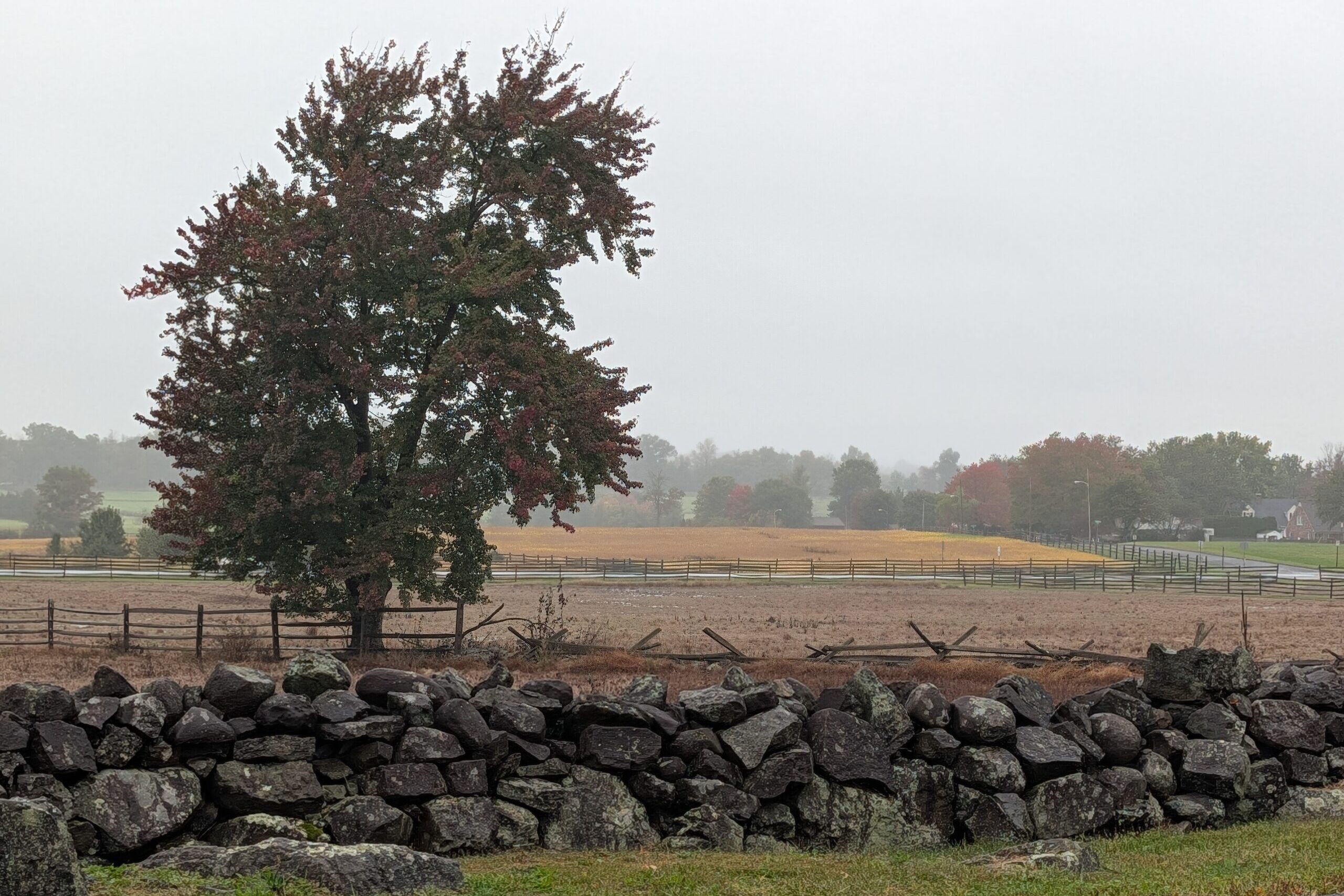
On a quiet autumn day, the Gettysburg battlefield seems almost peaceful. Stone walls border open fields, monuments rise among the trees, and winding roads lead visitors through a landscape where the events of the Civil War are still very much a part of the surroundings.
Yet Gettysburg has a reputation for being one of America's most haunted places. Visitors have described mysterious soldiers who appear and vanish, the distant sounds of battles that ended generations ago, and strange encounters that seem to transport witnesses into another century.
Are these stories simply folklore inspired by a place of extraordinary tragedy? Are they tricks of perception, or might there be something about Gettysburg that allows the past to intrude upon the present?
After visiting Gettysburg myself, I began thinking about another possibility. Perhaps some of these experiences have less to do with ghosts than with the way human consciousness connects us to the past.
The accounts that follow are part of Gettysburg's paranormal folklore. Some have historical foundations, while others survive primarily through retellings. They are fascinating stories, but not established evidence of supernatural events.
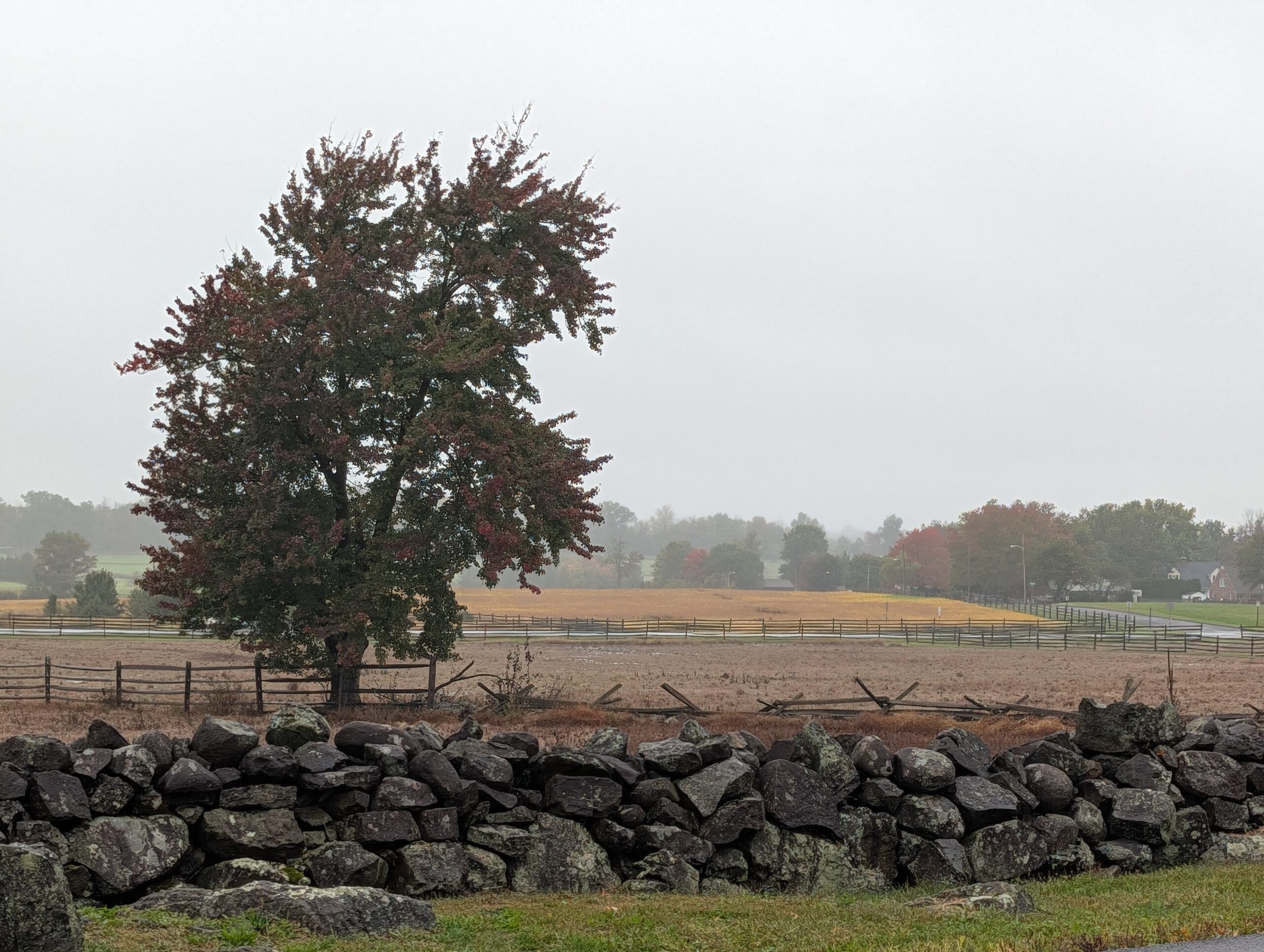
An autumn afternoon at Gettysburg, where peaceful fields and old stone walls conceal a violent history.
A Visit to Gettysburg
I recently visited Gettysburg National Military Park, where we explored the museum, viewed its collection of Civil War artifacts, visited several monuments, and drove through the cemetery and surrounding battlefield.
Our visit began with A New Birth of Freedom, the film narrated by Morgan Freeman. The presentation provides an overview of the Civil War and the events leading to the Battle of Gettysburg, where three days of fighting in July 1863 resulted in approximately 51,000 casualties, including soldiers killed, wounded, captured, or missing.
The most memorable experience, however, was the Cyclorama.
The Cyclorama is far more than an enormous panoramic painting. Standing in the observation area, surrounded by a 360-degree depiction of Pickett's Charge, it's surprisingly difficult to appreciate just how large the artwork really is.
Actual three-dimensional battlefield props and artifacts occupy the foreground, blending almost seamlessly into the painted landscape beyond. At times, it's difficult to determine where the physical objects end and the painting begins.
The illusion becomes even more convincing when the presentation begins. Dramatic lighting, projected effects, and powerful, remarkably realistic sounds of cannon fire, gunshots, and combat transform the enormous scene into something that feels almost alive. The scale is deceptive, the sense of depth extraordinary, and the emotional effect difficult to forget.
I found myself experiencing both admiration for the courage and sacrifice of those who fought and profound sadness over the tremendous suffering caused by the battle and the larger Civil War. These were human beings caught in a conflict of almost unimaginable violence, fighting a war whose central issue was slavery and the future of the nation.
When we left the museum and explored the battlefield, those emotions remained with me. The peaceful countryside seemed almost incompatible with the events that had taken place there.
And perhaps that contrast is one reason Gettysburg's ghost stories are so compelling.
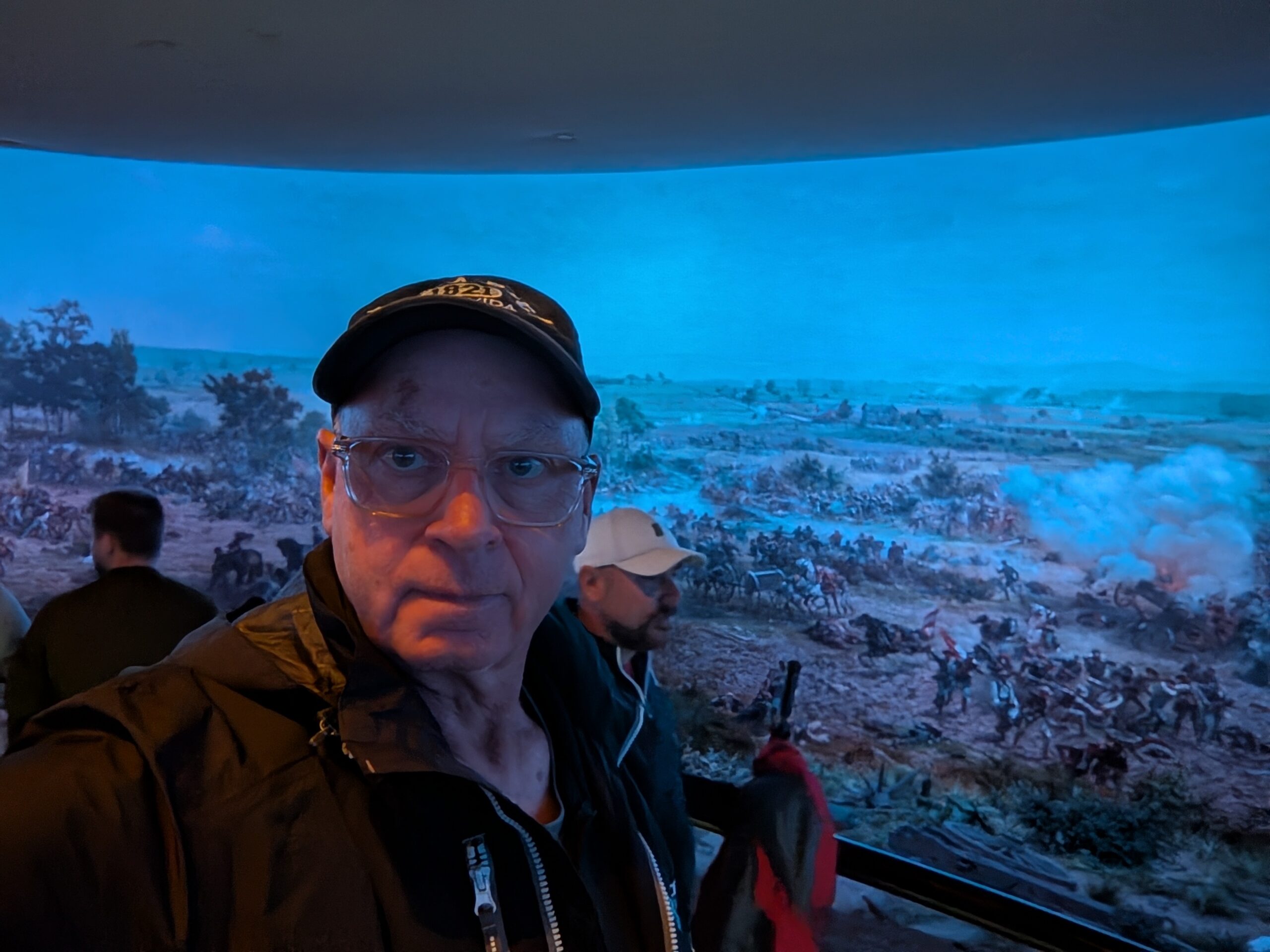
Inside the Gettysburg Cyclorama, where three-dimensional battlefield scenery blends into the enormous panoramic painting.
Devil's Den: The Mysterious Soldier Among the Rocks
Devil's Den is one of Gettysburg's most recognizable battlefield locations. Massive boulders create a maze of rocky passages and hiding places where Union and Confederate soldiers fought fiercely on July 2, 1863.
Today, the area is associated with one of Gettysburg's most frequently repeated ghost stories.
Visitors have described encountering a strange man with long hair, sometimes barefoot, wearing clothing resembling that of a Confederate soldier. In several versions of the story, the man appears unexpectedly, offers directions or advice, and then disappears before the visitors can find him again.
The mysterious figure has acquired the nickname the Helpful Hippy, partly because his long hair and informal appearance seem more appropriate to the 1960s than the 1860s.
Some accounts describe him as friendly, while others suggest that his appearance is unsettling. What makes the legend particularly curious is that the figure supposedly behaves like an ordinary person rather than a conventional ghost. Witnesses don't necessarily realize anything unusual has happened until he vanishes.
Devil's Den is also associated with reports of unexplained sounds, shadowy figures, and photographic anomalies. Visitors have claimed that cameras suddenly malfunction, batteries inexplicably fail, or unusual shapes appear in photographs taken among the rocks.
One particularly interesting aspect of the location is its association with Civil War photography. A famous image of a dead Confederate soldier among the rocks was staged by photographers who moved the body to create a more dramatic composition.
Even in 1863, appearances could be deceiving.
Little Round Top: A Visitor From Another Century?
Another well-known Gettysburg legend involves a mysterious soldier encountered near Little Round Top, the strategically important hill defended by Union troops during the second day of fighting.
One popular version of the story places the encounter during the filming of the 1993 movie Gettysburg.
According to the account, several Civil War reenactors working as extras encountered an unfamiliar older man wearing a worn Union uniform. He reportedly smelled of gunpowder and offered them ammunition, which they accepted without much thought.
After the stranger departed, the reenactors supposedly examined what he had given them and discovered that the ammunition appeared to be authentic Civil War-era material.
When they tried to locate the man, he had disappeared.
What makes this account particularly intriguing is the ammunition itself.
If the witnesses actually received physical objects from the mysterious stranger, the encounter would involve more than an apparition. Something tangible would have passed from one person to another.
That raises a fascinating question: If the man belonged to another time, how could he have carried physical objects into ours?
Most ghost stories involve sightings, sounds, or sensations. This account, if it happened as described, suggests something considerably stranger.
The ammunition is part of the reported legend, however, rather than independently established physical evidence. No verified chain of custody or authenticated examination has been established for the alleged cartridges.
But the physical-object element is precisely what makes the story stand apart.
If the ammunition was real, where did it come from? And what happened to it afterward?
Pennsylvania Hall: The Elevator That Opened Into the Past
Perhaps one of Gettysburg's strangest paranormal legends concerns Pennsylvania Hall at Gettysburg College.
During the Civil War, the building was used as a hospital for wounded soldiers. Like many buildings in and around Gettysburg, it witnessed extraordinary suffering as medical personnel struggled to care for men injured in the fighting.
According to a widely circulated story, two college employees entered an elevator in Pennsylvania Hall and experienced something extraordinary.
When the elevator doors opened, they allegedly found themselves looking into a Civil War hospital rather than the familiar college building. Wounded soldiers lay on the floor, medical personnel moved among them, and the scene appeared to belong entirely to the nineteenth century.
The witnesses reportedly watched in disbelief until the elevator doors closed. When they opened again, everything had returned to normal.
This account is particularly fascinating because it doesn't describe a single ghostly apparition. Instead, the witnesses supposedly encountered an entire scene from the past, complete with people and activity.
It also raises an interesting distinction. Were the witnesses supposedly looking at ghosts occupying their own time, or were they somehow perceiving an event from the past?
Those are two very different possibilities.
The Jennie Wade House: A Civilian Tragedy
Gettysburg's paranormal reputation isn't limited to the battlefield.
During the fighting, twenty-year-old Jennie Wade was preparing bread for Union soldiers when a bullet passed through the house where she was staying and killed her. She is remembered as the only civilian killed directly by gunfire during the battle.
Today, the Jennie Wade House is associated with reports of unexplained footsteps, mysterious voices, doors moving without an apparent cause, and the sensation of being watched.
Some visitors believe Jennie's spirit remains in the house, while other stories involve members of her family. One legend describes the apparition of a man appearing near an upstairs window.
Visitors have sometimes claimed to capture unusual figures or faces in photographs taken around the property.
The emotional power of Jennie's story is undeniable. Unlike the soldiers who marched into battle, she was a civilian whose life ended suddenly in a conflict that had engulfed her hometown.
It's not difficult to understand why people might imagine that such a tragic death left something behind.
Phantom Battles: When the Sounds Return
Some of Gettysburg's most unsettling reported experiences involve sounds rather than visible apparitions.
Visitors and local storytellers have described hearing distant cannon fire, gunshots, marching footsteps, shouted commands, and cries that seem to originate from empty fields.
The sounds are sometimes described as faint and distant, almost as though a battle were taking place somewhere beyond the surrounding hills. Other accounts suggest that the noises seem remarkably close, even though no reenactment or military demonstration is underway.
There are also stories of visitors experiencing sudden feelings of fear, sadness, or anxiety in particular locations, despite having no obvious reason for those emotions.
These accounts are difficult to evaluate. Gettysburg is a large, active historic site, and distant traffic, demonstrations, weather conditions, and ordinary environmental sounds can sometimes be misleading.
But the emotional experiences interest me just as much as the reported sounds.
What would cause someone to feel an overwhelming sense of grief while standing in a peaceful field? Is it simply the knowledge of what happened there, or might there be another explanation?
Residual Hauntings: Can the Past Replay Itself?
Paranormal investigators sometimes distinguish between two general types of hauntings.
An intelligent haunting supposedly involves a spirit that recognizes and interacts with living people. The apparition might respond to questions, acknowledge someone's presence, or behave as though it possesses awareness.
A residual haunting, by contrast, is described as an event that repeats without any apparent awareness of observers.
Imagine seeing a soldier march across a field, following the same route every time, without reacting to anyone nearby. Or hearing the same sequence of footsteps in an empty hallway night after night.
According to the residual haunting hypothesis, these experiences are not encounters with conscious spirits. Instead, they are impressions of past events somehow preserved and replayed.
One speculative explanation, sometimes called the Stone Tape Theory, proposes that materials in the environment might retain information associated with powerful emotional events.
But that raises an interesting question.
What if the environment isn't actually storing the memory? What if the memory exists somewhere else, and the location simply helps us access it?
Collective Consciousness: Are We Remembering Someone Else's Experiences?
I've long been intrigued by the possibility that human consciousness might be more interconnected than we realize.
Carl Jung introduced the concept of the collective unconscious, proposing that human beings share inherited psychological patterns and archetypes. His theory wasn't about literally retrieving another person's memories, but it provides an interesting starting point for thinking about shared aspects of consciousness.
Other traditions have proposed more expansive ideas.
The Akashic Records, for example, are described in certain esoteric traditions as a universal repository containing information about thoughts, actions, and experiences.
And the controversial hypothesis of morphic resonance proposes that patterns established in the past might influence similar systems in the present.
Another idea, explored by some philosophers and researchers, is that the brain might function partly as a receiver or filter of consciousness rather than being solely responsible for generating it.
Imagine a radio. The radio doesn't create the broadcast. It receives signals from an external source and converts them into something we can hear.
Could the human brain work in a somewhat similar way?
Perhaps consciousness exists within some kind of field or interconnected system, and our brains interact with it. Some individuals might be more receptive than others, just as some receivers are more sensitive to particular signals.
This is a philosophical and speculative model, not an established neuroscientific explanation. There is no demonstrated external consciousness field that brains have been shown to receive.
Nevertheless, the analogy provides an interesting way to think about the possibility of shared experiences.
My own speculation combines several of these ideas.
What if every living thing contributes to a shared consciousness, and what if other living things can sometimes access that information?
Perhaps the connection is usually unconscious. It might appear as intuition, an unexpected insight, or even something resembling instinct.
We know that instinctive behaviors are strongly influenced by inherited biology and evolution. Likewise, similar discoveries made independently by different people can often be explained by shared knowledge, circumstances, and technological developments.
But I still find it interesting to ask whether those explanations represent the entire picture.
Now consider Gettysburg.
During three days in July 1863, thousands of people experienced extraordinary fear, pain, determination, courage, and grief within a relatively small geographical area.
What if those experiences contributed something to a larger collective consciousness?
And what if the battlefield itself somehow makes those impressions easier to access?
Perhaps certain individuals are more receptive to this information than others. A person standing where soldiers once fought might experience a fleeting impression of fear, hear something resembling distant gunfire, or briefly perceive a figure from another century.
Under this hypothetical explanation, the experience wouldn't necessarily involve a surviving spirit. It might be closer to accessing someone else's memory.
The person experiencing it might have no idea where the impression originated. To them, it could feel like an external event occurring in the present.
Perhaps the battlefield is not storing these experiences at all. Perhaps it serves as a trigger that helps certain minds connect with impressions preserved in a shared consciousness.
That would offer an alternative interpretation of some reported hauntings.
Instead of asking whether Gettysburg is haunted by the dead, perhaps we should ask whether the experiences of the dead remain accessible to the living.
Why Some People Experience Something and Others Don't
One of the enduring mysteries of reported hauntings is why experiences seem to vary so dramatically between individuals.
Two people may visit the same location, at the same time, and report entirely different sensations. One may experience something unusual while the other notices nothing.
There are conventional explanations for this. People differ in their expectations, attention, emotional sensitivity, and interpretation of ambiguous sights and sounds.
But within the collective consciousness hypothesis, another possibility emerges.
Perhaps some individuals are more receptive to impressions from a shared consciousness, just as people differ in other perceptual and cognitive abilities.
If the brain were functioning partly as a receiver, perhaps some minds would be more sensitive to certain kinds of information. A location associated with intense historical events might act as a trigger, making impressions that are normally inaccessible easier to experience.
That could explain, within the hypothesis, why one visitor reports a vivid apparition while another standing nearby experiences nothing at all.
It's an intriguing possibility, particularly when considered alongside the many stories associated with Gettysburg.
The Battlefield Today
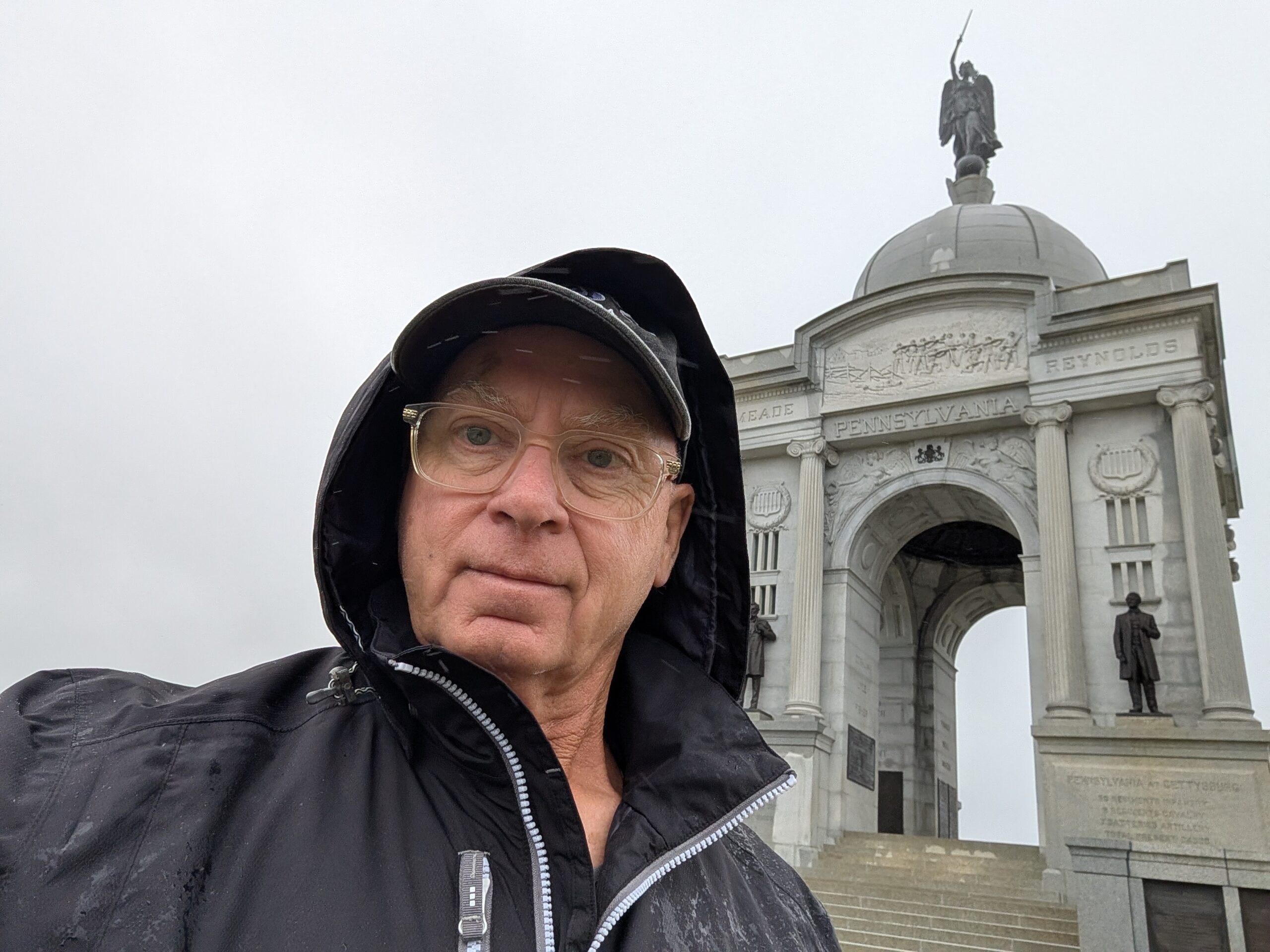
During our visit, we stopped at several monuments, including the impressive Pennsylvania State Memorial and a monument honoring Minnesota soldiers. We also drove through the cemetery, where the human cost of the battle becomes particularly difficult to ignore.
The countryside was peaceful beneath the gray autumn sky. The monuments stood among trees beginning to change color, and the surrounding fields seemed far removed from the violence that once consumed them.
I didn't see a ghost during my visit, and I didn't experience anything I would describe as supernatural.
But I did feel a powerful connection to the history of the place, particularly after the emotional experience of the Cyclorama presentation.
And I found myself wondering whether that connection might sometimes take forms we don't fully understand.
Perhaps Gettysburg's ghost stories are simply the products of folklore, imagination, and the emotional weight of history. Perhaps ordinary sounds and visual impressions become extraordinary when experienced in a location associated with so much suffering.
Or perhaps human consciousness retains more information than we realize, and certain places allow us to experience fragments of the past in unexpected ways.
The battle ended more than 160 years ago, but its influence remains deeply embedded in American history and memory.
Whether its ghosts are spirits, echoes, illusions, or something we haven't yet imagined, Gettysburg continues to remind us that the past can feel remarkably close.
And perhaps the most intriguing possibility is that we aren't seeing ghosts at all. Perhaps, somehow, we're remembering people we've never met.
Have you visited Gettysburg or another historic location where you experienced something unusual? I'd be interested in hearing your story in the comments.
Enter the Fray explores mysteries, folklore, paranormal experiences, and the possibilities that challenge our understanding of reality.