
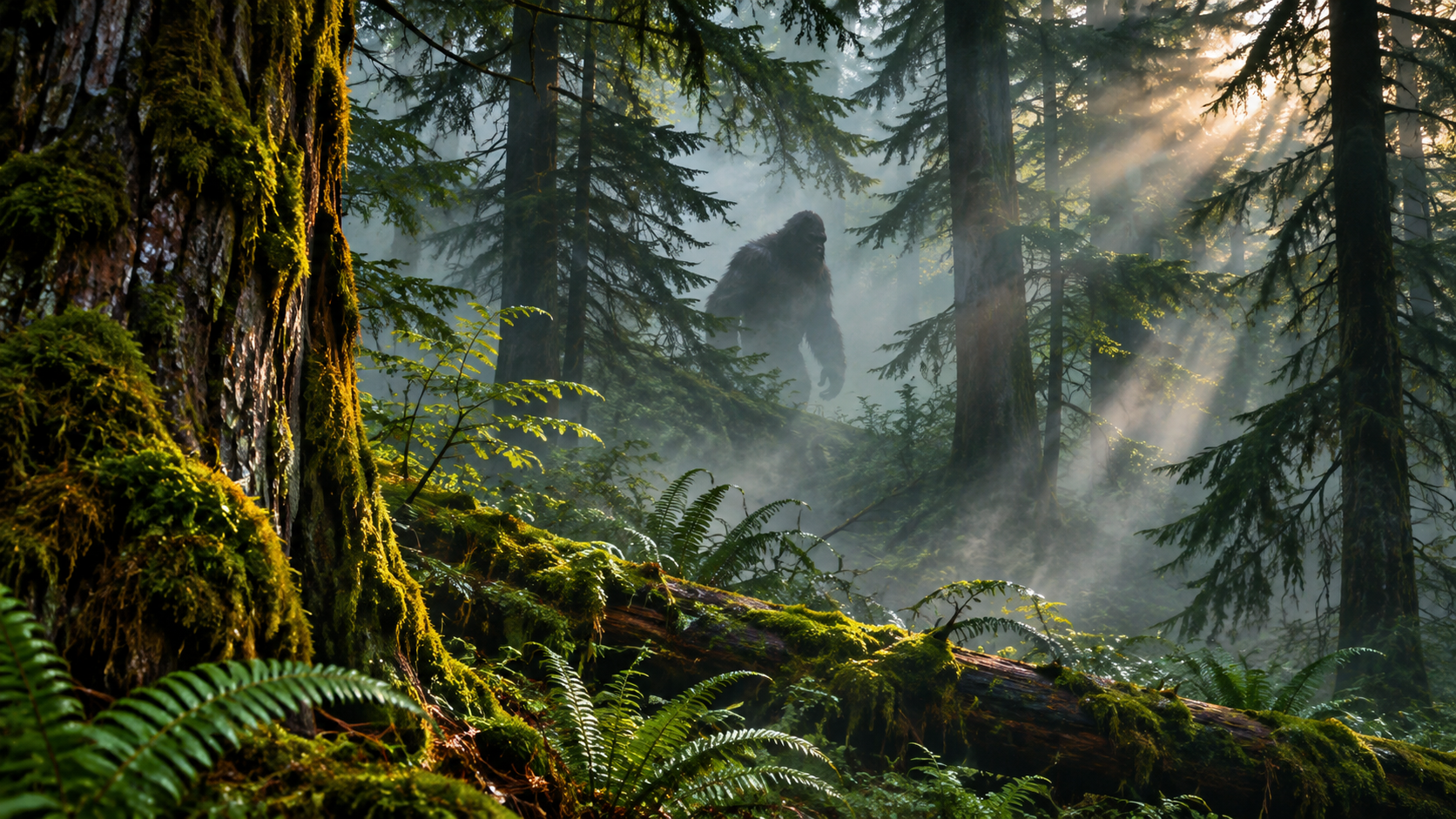
Some call it a gentle giant. Others describe a monster lurking in the wilderness. But what if the truth—assuming there is one—is far more complicated?
Something in the Woods
There are places in the wilderness where the trees grow so close together that daylight struggles to reach the forest floor. Places where you can walk for miles without encountering another human being, and where every snapping branch makes you wonder what might be moving just beyond sight.
Now imagine you’re hiking through one of those forests when the birds suddenly fall silent. You stop, listening, and somewhere among the trees, something moves. Something big.
At first, you think it’s a bear. But then the creature steps into a narrow shaft of sunlight, and you realize it’s standing upright. Not balancing awkwardly on its hind legs, but standing as naturally as you do. It’s enormous, covered in dark hair, and looking directly at you. For one uncomfortable moment, neither of you moves. Then it turns and disappears into the forest.
Congratulations. You’ve just experienced the kind of encounter that has made Bigfoot one of the most enduring mysteries in the world.
Of course, our little walk through the woods was imaginary. But people have reported encounters with something remarkably similar for generations. And while their descriptions often share certain features, the creatures’ alleged personalities are another matter entirely. Some witnesses describe a shy, gentle giant that wants nothing to do with humanity. Others tell stories of something far less agreeable—something that screams in the darkness, hurls rocks at intruders, or follows unsuspecting campers through the woods.
Which raises an interesting question. What if they’re both right?
Older Than the Name Bigfoot
Long before anyone thought to name a mysterious creature after its oversized feet, stories of wild, humanlike beings circulated through the forests and mountains of North America.
For some Indigenous peoples, such beings were more than creatures of the wilderness. They belonged to traditions woven into the spiritual and cultural understanding of the land itself. Among the Sts’ailes people of British Columbia, Sasq’ets holds particular significance as a caretaker watching over the land. The name would eventually help give rise to the familiar English word Sasquatch.
Other Indigenous communities have their own traditions involving wild people, forest dwellers, and powerful beings inhabiting places beyond ordinary human settlement. Some are protectors, while others are dangerous. Still others belong to spiritual traditions that don’t fit neatly into our modern categories of animal, human, or supernatural entity. These traditions aren’t interchangeable, and their meanings deserve to be understood within the cultures that preserve them.
But they remind us that the modern Bigfoot phenomenon didn’t emerge from an empty wilderness. The idea of something humanlike living beyond the boundaries of civilization has been with us for a very long time, and eventually, stories of mysterious forest creatures found their way into newspapers.
The Night the Shadows Came Knocking
In the summer of 1924, five prospectors working near Mount St. Helens, Washington, reported an encounter that would become one of the most notorious episodes in Bigfoot history. The place would eventually become known as Ape Canyon.
According to the men’s account, they had discovered enormous footprints and encountered strange, hairy creatures in the surrounding wilderness. One of the prospectors reportedly fired at a creature, believing it posed a threat. That decision, if the story unfolded as described, may have been a spectacular mistake.
Later, while the men sheltered inside their cabin, something began striking the building. Rocks crashed against the roof, and more rocks followed. The men claimed that enormous creatures were outside, hurling stones, pounding against the walls, and attempting to get inside. They spent the night barricaded in the cabin, listening to the assault and wondering whether the walls would hold.
Imagine the helplessness of that situation. A remote mountain cabin, miles of wilderness in every direction, something powerful moving outside in the darkness, and no convenient emergency number to call.
By morning, according to the story, the attackers had vanished. The prospectors survived to tell their tale, which appeared in newspaper accounts that same summer.
One of the men, Fred Beck, later provided a more elaborate recollection of the experience. In his telling, the creatures had been appearing around the prospectors’ camp before the confrontation, and the attack seemed anything but accidental.
Whether the men encountered unknown animals, experienced some other frightening event, or contributed to an extraordinary wilderness legend remains a matter of interpretation. But the story introduced a version of Bigfoot considerably less interested in peaceful coexistence than the shy forest giant of modern popular imagination.
These creatures, the prospectors claimed, were angry—and they were capable of working together.
Kidnapped by Giants
If Ape Canyon represents Bigfoot at its most threatening, another famous account offers something stranger.
Canadian prospector Albert Ostman claimed that in 1924, while camping near British Columbia’s Toba Inlet, he awoke to discover that something had picked up his sleeping bag—with him still inside it.
Whatever carried him was immensely strong. According to his account, he was transported through the forest and eventually deposited in a remote location, where he found himself surrounded by four enormous, hairy beings.
A family.
Ostman described an adult male, an adult female, and two younger creatures. He claimed that the beings watched him, examined his belongings, and prevented him from leaving. His alleged captors were not particularly interested in conversation, but neither did they immediately attempt to kill him.
Ostman said he spent several days among the creatures before escaping after giving the adult male some snuff tobacco, which caused an unpleasant reaction and provided an opportunity to flee. His account became widely known decades after the alleged encounter, particularly through the efforts of Sasquatch researchers.
It’s a wonderfully bizarre story. A man kidnapped in his sleeping bag, held by a family of mysterious forest giants, and ultimately rescued by the questionable pleasures of tobacco. Hollywood could hardly ask for a better premise.
Yet beneath the extraordinary details lies something relevant to our investigation. Ostman didn’t describe a mindless monster. He described a social group, complete with adults and offspring, whose members seemed to possess different temperaments and behaviors. If his account were accurate, it would suggest something far more complicated than a solitary animal wandering the mountains.
And that brings us to one of the most intriguing aspects of the Bigfoot mystery.
A Creature with Many Names
Travel far enough from the forests of North America, and the names change. The descriptions, however, can sound strangely familiar.
In Florida’s swamps, the Skunk Ape allegedly prowls through tangled vegetation, earning its name from the powerful odor sometimes associated with encounters. High in the Himalayas, the Yeti has haunted the imaginations of mountaineers, explorers, and local communities for generations. Australia has the Yowie, a mysterious hairy figure reported in remote bushland, while parts of Central Asia and the Caucasus have traditions involving wild, humanlike beings sometimes identified as the Almasty.

The details vary. Some creatures are described as enormous and powerful, while others are more humanlike. Some belong to spiritual traditions, while others appear primarily in modern eyewitness reports. And not every tradition can be reduced to a single biological creature.
Still, there’s something remarkable about the recurring image. Across distant continents, separated by mountains, oceans, languages, and cultures, people have told stories about strange beings inhabiting the wild places beyond human settlement.
Are these accounts distant echoes of a shared human fear? Could encounters with known animals have inspired similar legends in different places? Or might there be something about the wilderness itself that encourages humanity to imagine—or occasionally glimpse—another kind of inhabitant?
The answer may be different for every tradition, but the question is difficult to resist.
Gentle Giant or Malevolent Monster?
Consider two very different encounters.
In the first, a hunter notices an enormous figure standing among the trees. The creature watches him for several moments, then turns and quietly disappears. In the second, a group of campers hears terrible screams in the darkness. Something large moves around their campsite, and rocks strike the ground nearby. The campers flee, convinced that whatever followed them intended to do harm.
Both imagined scenarios resemble patterns found in reported Bigfoot encounters. One suggests a shy, intelligent creature that prefers to avoid confrontation. The other suggests something territorial, aggressive, and potentially dangerous.
Some stories go further. There are allegations of Bigfoot creatures stalking people, chasing vehicles, and even abducting humans. Certain fringe theories attempt to connect mysterious wilderness disappearances to these creatures. People disappear in remote areas for many reasons, however, and no reliable evidence establishes Bigfoot as the cause of such disappearances.
But as part of the folklore, these darker stories reveal how dramatically the creature’s reputation can change. A guardian of the forest in one account, a terrifying predator in another.
We tend to think of animal species as having recognizable behavioral patterns. Bears behave like bears, and wolves behave like wolves. Yet anyone who has spent time around animals knows that individuals can be surprisingly different. Some are bold, some are timid, some are curious, and others seem perpetually annoyed with the entire world.
Among highly social animals, those differences can become even more interesting. Which leads to a possibility worth exploring.
What if Bigfoot isn’t simply an animal behaving according to instinct? What if it’s something closer to us?
What If Bigfoot Is More Like Us?
Let’s imagine, for a moment, that Bigfoot exists. Not as a supernatural apparition or a wandering monster, but as a living population of intelligent, humanlike beings inhabiting remote wilderness areas.
Suppose these creatures possess sophisticated communication, strong family bonds, and the ability to learn from experience. Perhaps they even develop traditions.
Now imagine two groups living in different regions. One occupies a remote mountain valley where human visitors rarely venture. Its members have little reason to fear people. When someone enters their territory, they observe from a distance, perhaps curious about these noisy, strangely dressed intruders.
Another group inhabits a forest where hunting, logging, and human development have steadily encroached upon its territory. Its members have learned a different lesson: humans are dangerous. They carry weapons, destroy habitat, and bring machines into places that were once quiet.
Perhaps this group has developed a habit of frightening intruders away, screaming from the darkness, throwing rocks, and making itself appear as threatening as possible.
A third group might avoid contact altogether, teaching its young to retreat whenever humans approach. Three groups, three different responses to the same species, and suddenly, the contradictory eyewitness accounts don’t seem quite so contradictory.
We’re exploring a hypothetical society here, but the underlying idea has interesting parallels in the natural world. Chimpanzees exhibit complex social relationships and behaviors that can differ between communities. Other primates demonstrate social learning, individual personalities, and traditions passed between generations.
Human beings take those differences considerably further. Our beliefs, customs, experiences, and relationships influence how we respond to outsiders. One community may welcome strangers, while another regards them with suspicion.
If Bigfoot possessed anything approaching that level of social intelligence, might its behavior vary just as dramatically?
And consider another possibility. What if some groups have learned that the best way to survive is never to be seen? Not merely to run away from people, but to recognize human activity, understand our habits, and deliberately avoid places where encounters are likely.
Imagine generations of creatures learning that a distant engine means danger, that a trail camera should be avoided, or that a human scent means it’s time to disappear. It would make finding them considerably more difficult, but it would also raise another question.
How intelligent would such a creature need to be?
We might be looking not simply for an undiscovered primate, but for something capable of recognizing our intentions and adapting its behavior accordingly.
That’s a fascinating possibility, and one that makes the stubborn absence of physical evidence even more intriguing.
The Evidence That Isn’t There
For a creature reportedly encountered across vast stretches of North America, Bigfoot has proven remarkably reluctant to leave anything behind.
There are photographs, of course. Usually blurry ones.
Comedian Mitch Hedberg once built a memorable joke around the idea that perhaps Bigfoot itself is blurry, and that’s the problem. The joke has endured because it captures something frustrating about the entire phenomenon. For decades, people have claimed to photograph or film Bigfoot, yet the resulting images rarely settle anything.
The most famous example is the Patterson–Gimlin film, recorded near Bluff Creek, California, in October 1967. The footage shows a large, hair-covered figure walking across a clearing. It turns toward the camera, offering a brief view of its face and upper body, then continues toward the trees.
Supporters have spent decades analyzing the figure’s gait, proportions, and apparent musculature. Skeptics see something else: a person in a costume. The debate continues, and the short film has become one of the most recognizable pieces of footage in cryptozoology.
Then there are the footprints. Enormous tracks have been discovered in forests, along creek beds, and on remote trails. Some have been preserved as plaster casts, displaying details that enthusiasts believe would be difficult to fabricate. Others have been exposed as hoaxes.
In fact, the modern name Bigfoot became widely known after enormous tracks were reported near a northern California logging operation in 1958. Newspaper coverage turned a local mystery into a national sensation. Some tracks associated with that period were later linked to carved wooden feet.
Hair samples have also attracted scientific attention. In 2014, researchers published a genetic study of thirty hair samples that yielded DNA and had been attributed to Bigfoot, Yeti, and other alleged unknown primates. Their genetic sequences matched known mammals, although two Himalayan samples raised an interesting question about bear ancestry that researchers subsequently examined further.
Bears, deer, raccoons, and other familiar creatures have a habit of turning up where an unknown primate was expected.
A 2024 study in the Journal of Zoology added another wrinkle. Examining Bigfoot reports alongside black bear populations across the United States and Canada, the researcher found that areas with more bears tended to produce more Bigfoot sightings, even after accounting for human population and forest area.
Perhaps some of those enormous, upright figures glimpsed between the trees were bears after all.
And despite generations of searching, nobody has produced an authenticated Bigfoot body or skeleton. No confirmed bones, no established fossil record of a surviving North American giant primate, and no verified DNA demonstrating that such a species exists.
For skeptics, the conclusion is straightforward. A population of enormous creatures should leave more than stories and footprints. Even if the animals were extraordinarily cautious, they would still need food, shelter, and breeding populations. They would eventually die, leaving remains that might be discovered.
Yet the mystery persists, partly because the evidence is so elusive, and partly because people continue to report encounters that they cannot explain.
The World’s Most Famous Missing Creature
Whatever Bigfoot may be, the creature has managed to accomplish something remarkable. It has become a celebrity without ever granting an interview.
Bigfoot appears in movies, television shows, advertisements, books, T-shirts, bumper stickers, and enough roadside souvenirs to suggest that the creature has a surprisingly effective marketing department. Entire communities have embraced the legend. Festivals celebrate it, gift shops profit from it, and roadside attractions invite visitors to pose beside towering statues of a creature supposedly famous for avoiding human contact.
I’ve encountered this fascination firsthand. During a visit to Michigan’s Upper Peninsula, I was surprised by the sheer number of Bigfoot references appearing on signs, storefronts, and tourist merchandise. The Upper Peninsula has no shortage of genuine wilderness, but I hadn’t expected Sasquatch to have such an enthusiastic presence in its commercial districts.
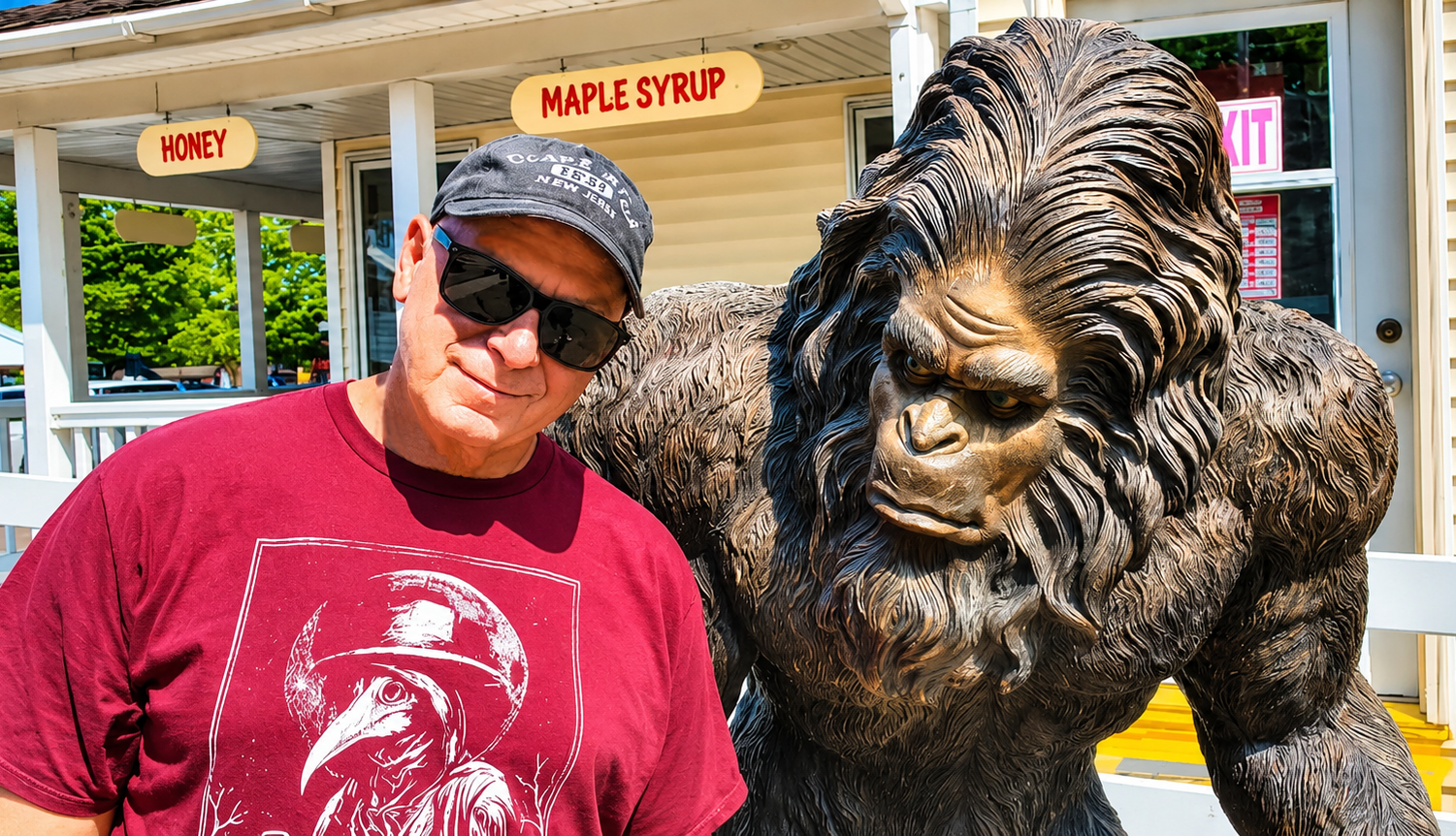
Bigfoot makes an appearance in Michigan’s Upper Peninsula—at least in the form of a roadside attraction. Photo from the author’s collection.
On another trip, I visited Skunk Ape Headquarters in Ochopee, Florida, where the local version of the legend has become a tourist attraction. Naturally, I couldn’t resist posing for photographs.
There’s something wonderfully ironic about it all. Here is a creature that has supposedly spent generations hiding from humanity, yet its image is practically impossible to escape.
And perhaps that’s part of Bigfoot’s appeal. In a world increasingly mapped, photographed, monitored, and cataloged, the possibility that something enormous could still remain undiscovered feels almost rebellious. We want to believe there are places beyond our reach, places where the wilderness hasn’t surrendered every secret.

And perhaps somewhere, behind a wall of trees, something is watching us with the same curiosity we feel toward it.
The Lingering Question
The Bigfoot mystery is full of contradictions. A creature described as both gentle and terrifying. A being supposedly intelligent enough to avoid humanity, yet occasionally careless enough to wander across a road in front of startled motorists. An enormous animal that leaves giant footprints but no confirmed bones. A worldwide collection of legends that seem strangely familiar, yet emerge from cultures with very different histories and beliefs.
There are explanations for many of these contradictions: misidentified animals, hoaxes, folklore, exaggerated stories, and the human tendency to find familiar shapes in shadows and movement. But there are also witnesses who insist that what they encountered was unlike anything they’d ever seen.
Some are experienced outdoorspeople who have spent much of their lives among the animals of the wilderness. Their experience doesn’t make them infallible, but it does make their stories worth hearing.
Perhaps the answer lies entirely within the familiar world. Perhaps Bigfoot is a modern legend built from ancient traditions, mistaken encounters, and the remarkable human imagination. Or perhaps some small part of the mystery remains unexplained.
And if Bigfoot does exist, perhaps the most interesting question isn’t whether it’s an animal or a monster. Perhaps it’s whether we’ve been asking the wrong questions about its nature all along.
Imagine that somewhere in a remote forest, a young Sasquatch is being taught by its elders to avoid the strange, noisy creatures that sometimes wander into its territory. Perhaps those elders have stories of their own—stories about dangerous beings who travel in metal machines, carry strange weapons, and occasionally leave behind mysterious objects that flash and click.
Perhaps they even have a name for us.
And perhaps, when the young ones ask whether humans are real, the elders simply smile.
After all, there’s very little proof that we exist.
At least, not from the perspective of a young Sasquatch living in a remote mountain valley.
Sources & Further Reading
Story of the Sasquatch — Sts’ailes First Nation
The Night the Shadows Came Knocking
The Mystery Doesn’t End Here
Bigfoot may be the world’s most famous mystery lurking in the wilderness, but it is hardly the only one. Across centuries and continents, people have reported encounters with things that seem to defy explanation. Some become legends. Others leave behind questions that refuse to disappear.
Perhaps the next mystery is waiting just beyond the trees.
Explore more mysteries:
Extraordinary Encounters When ordinary people experience something extraordinary.
Supernatural Folklore Where ancient traditions meet the unexplained.
Or venture deeper into The Unknown Where mysteries lead to questions about the very nature of reality.