
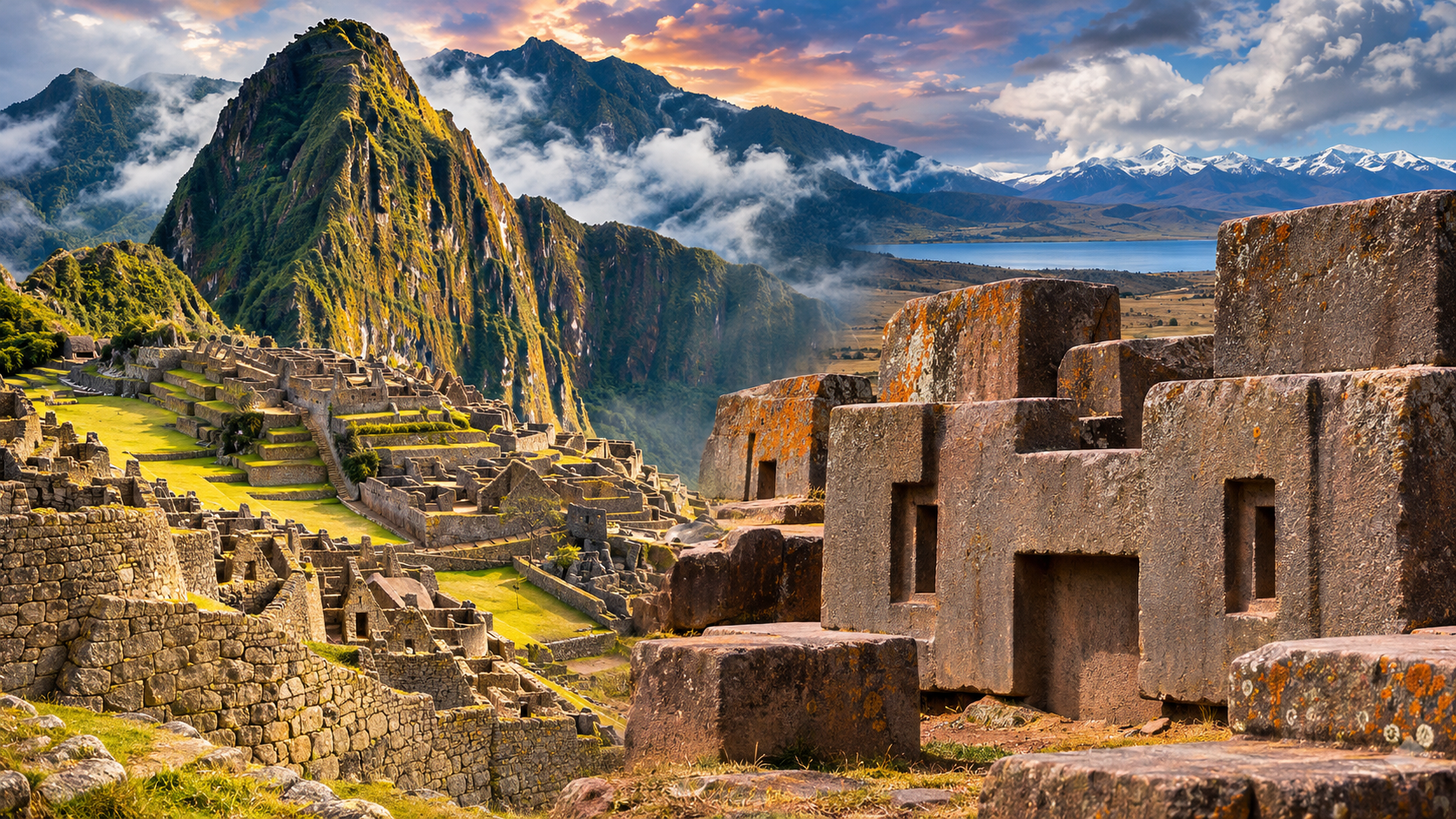
Two ancient civilizations, two extraordinary approaches to building—and the mysteries of what made it all worthwhile.
When Stone Inspires Awe
There are places in this world where the accomplishments of people who lived centuries ago can leave you feeling surprisingly small.
Imagine standing among the ruins of Machu Picchu, high in the Peruvian Andes. Mountains rise around you like enormous green sentinels, their summits disappearing into drifting clouds. Far below, a river winds through the valley, while terraces and stone stairways cling to a ridge that seems an unlikely place to build anything, much less an elaborate settlement.
The setting alone is breathtaking. But as you walk among the buildings, your attention shifts from the mountains to something considerably smaller: a stone wall.
At first glance, it might seem ordinary enough. Then you notice the shapes of the individual stones. Some have five sides, others six or more. Their angles are irregular, their dimensions vary, and their surfaces appear to have been shaped specifically to accommodate the stones around them. Yet the blocks fit together with remarkable precision, creating joints so tight that in some places even a knife blade would struggle to slip between them.
You might find yourself running a hand along one of those complicated joints, wondering how anyone managed to achieve such a fit. Then you look around and realize that this wall represents only a tiny fraction of an enormous undertaking. Buildings, terraces, stairways, and drainage systems extend across the mountainside, each representing countless hours of labor and accumulated expertise.
Now imagine traveling southeast through the Andes, crossing into the highlands of Bolivia, where another ancient civilization left behind an equally remarkable collection of stones.
At Puma Punku, near Lake Titicaca, the experience is quite different. Instead of recognizable buildings and terraces, you encounter enormous stone slabs and scattered architectural components. Some are immense, while others have been carved into precise geometric shapes, with straight grooves, sharply defined recesses, and carefully formed angles. Several resemble enormous stone versions of the letter H.
The workmanship is striking, but so is the contrast.
At Machu Picchu, the finest masonry can look almost organic, as though irregular stones somehow grew together into walls. At Puma Punku, some of the surviving blocks look remarkably engineered, their repeated shapes suggesting components manufactured according to a deliberate architectural plan.
Both sites inspire awe. Both represent extraordinary achievements in stoneworking. Yet their builders approached the material in noticeably different ways. And although the stones themselves have survived, much of the knowledge, ambition, and meaning behind their construction has disappeared.
What stories might they still have to tell?
A Mountain Transformed
Machu Picchu was constructed during the fifteenth century, when the Inca Empire extended across much of western South America. Its builders selected a dramatic mountain ridge more than 7,000 feet above sea level, surrounded by steep slopes, rugged peaks, and deep valleys.
From a modern construction perspective, the location presents an impressive collection of difficulties. The terrain is uneven, rainfall can be substantial, and transporting materials through the mountains would have required careful planning. Even today, constructing a settlement in such a setting would be no small undertaking.
Yet the Inca didn’t merely overcome the landscape. They made it part of their architecture.
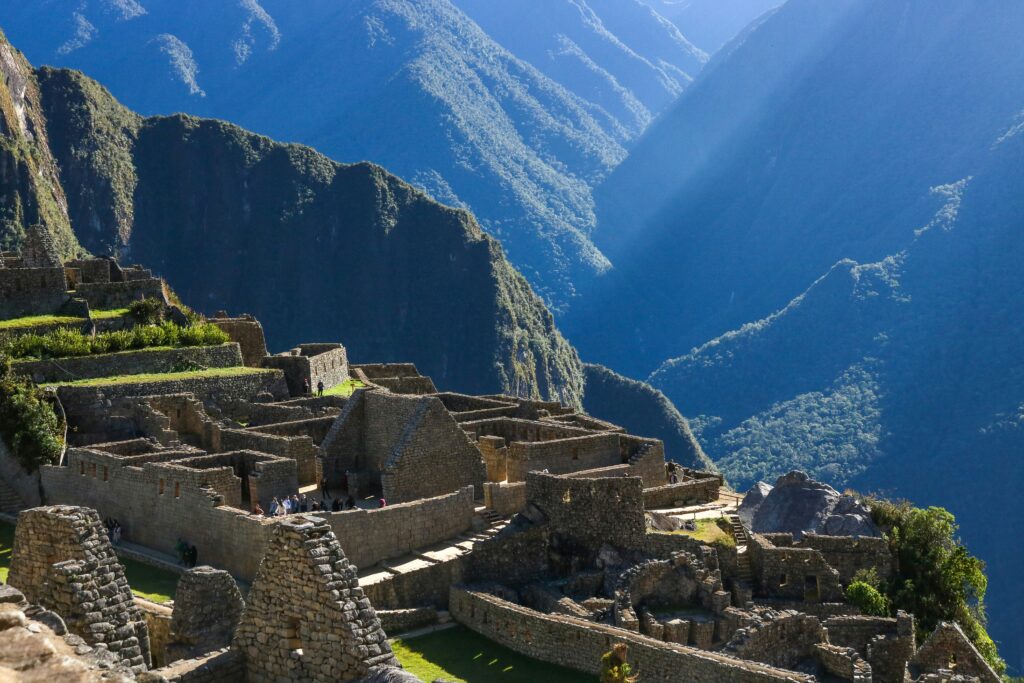
Machu Picchu’s buildings and terraces cling to a dramatic mountain ridge in the Peruvian Andes. Photo: Jonathan Phelps / Unsplash.
Terraces follow the contours of the slopes, helping stabilize the terrain while creating usable spaces. Stairways connect different levels of the settlement. Buildings incorporate natural rock formations, and an elaborate drainage system helps manage the water that might otherwise threaten the structures.
Throughout the site, stone dominates the architecture.
Machu Picchu contains several styles of masonry, ranging from comparatively simple construction to finely worked blocks assembled with extraordinary care. The most memorable examples involve polygonal stones whose irregular shapes fit together like pieces of an exceptionally complicated three-dimensional puzzle. The same tradition of remarkable stoneworking can be seen elsewhere in the Inca world, including the famous Twelve-Angled Stone in Cusco, where a single irregular block fits precisely against its many neighbors.
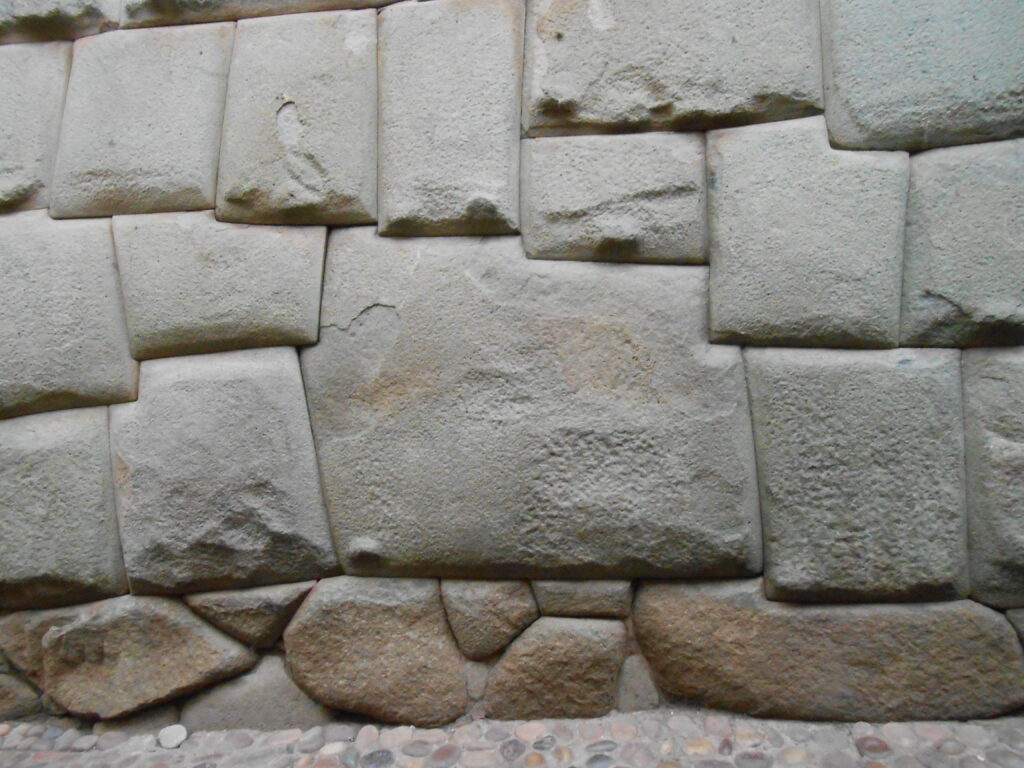
The famous Twelve-Angled Stone in Cusco demonstrates the extraordinary precision of Inca polygonal masonry. Original Photo – License
Consider what that means for the people who built them.
A stoneworker preparing a block for one of these walls might need to shape several surfaces to match neighboring stones. Each adjustment could affect the fit of the entire piece. A mistake might require further shaping, repositioning, or selecting another block. Multiply that process across hundreds or thousands of stones, and the scale of the undertaking becomes difficult to comprehend.
The builders also had to consider how the finished structure would behave. Stones needed to remain stable, walls needed to support loads, and the entire construction had to function within a mountainous environment.
Fortunately, the Inca possessed a substantial advantage: much of the granite used at Machu Picchu was available locally, including within the settlement itself. Natural fractures provided opportunities for extracting and shaping stone without transporting every block from a distant quarry.
But convenient access to material didn’t make the craftsmanship easy.
Archaeologist Jean-Pierre Protzen studied Inca quarrying and stonecutting techniques, demonstrating through experiments how hammerstones and repeated shaping could produce remarkably precise masonry. His work helped establish that sophisticated stonework could be accomplished using relatively simple tools, provided the workers possessed the necessary skill and experience.
The Inca understood stone in ways that most of us never will. Their craftsmen could recognize useful fractures, anticipate how a block might respond to repeated blows, refine complicated surfaces, and judge how individual pieces would function within a larger structure.
Those abilities were the product of traditions developed, practiced, and refined across generations.
The Stone Puzzle of Puma Punku
Several centuries before the Inca constructed Machu Picchu, the Tiwanaku civilization was developing its own tradition of monumental architecture in the highlands surrounding Lake Titicaca.
The Tiwanaku cultural center, in present-day Bolivia, contained elaborate buildings, plazas, platforms, and monumental gateways. Among its architectural achievements was Puma Punku, a complex whose surviving stones continue to provoke fascination.
Unlike Machu Picchu, Puma Punku does not immediately present visitors with a recognizable architectural landscape. Its original structures have been extensively damaged and dismantled, leaving enormous slabs and carefully worked blocks scattered across the site.
Some of those blocks are extraordinary.
Massive sandstone slabs formed part of the monument’s foundations and platforms. Other architectural elements were fashioned from andesite, a volcanic rock that can be worked into carefully defined surfaces and shapes.
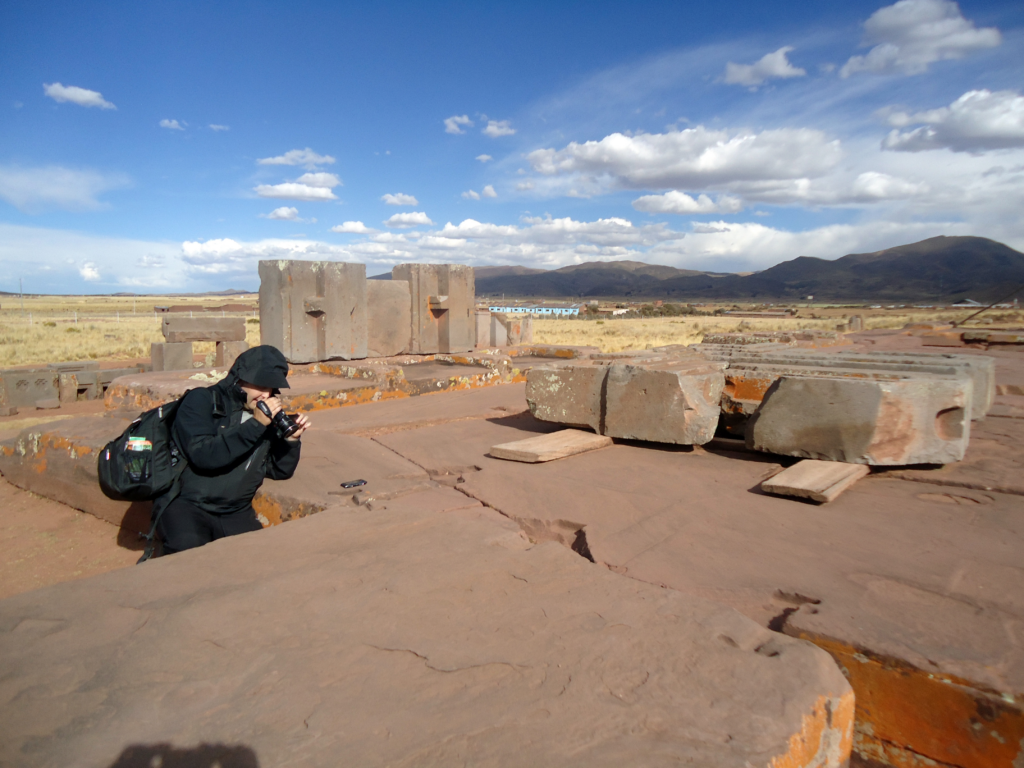
Massive stone slabs at Puma Punku reveal the extraordinary scale of construction undertaken by the Tiwanaku civilization. Original Photo – License
The famous H-shaped blocks are particularly intriguing. Their straight edges, recesses, and repeated geometric features suggest a sophisticated architectural system in which individual components were designed to fit into larger arrangements.
To someone accustomed to modern manufacturing, certain pieces might resemble prefabricated components awaiting assembly. It’s an understandable impression, although the comparison shouldn’t be taken to mean the builders used industrial machinery. The geometric precision is remarkable enough without introducing unsupported technologies.
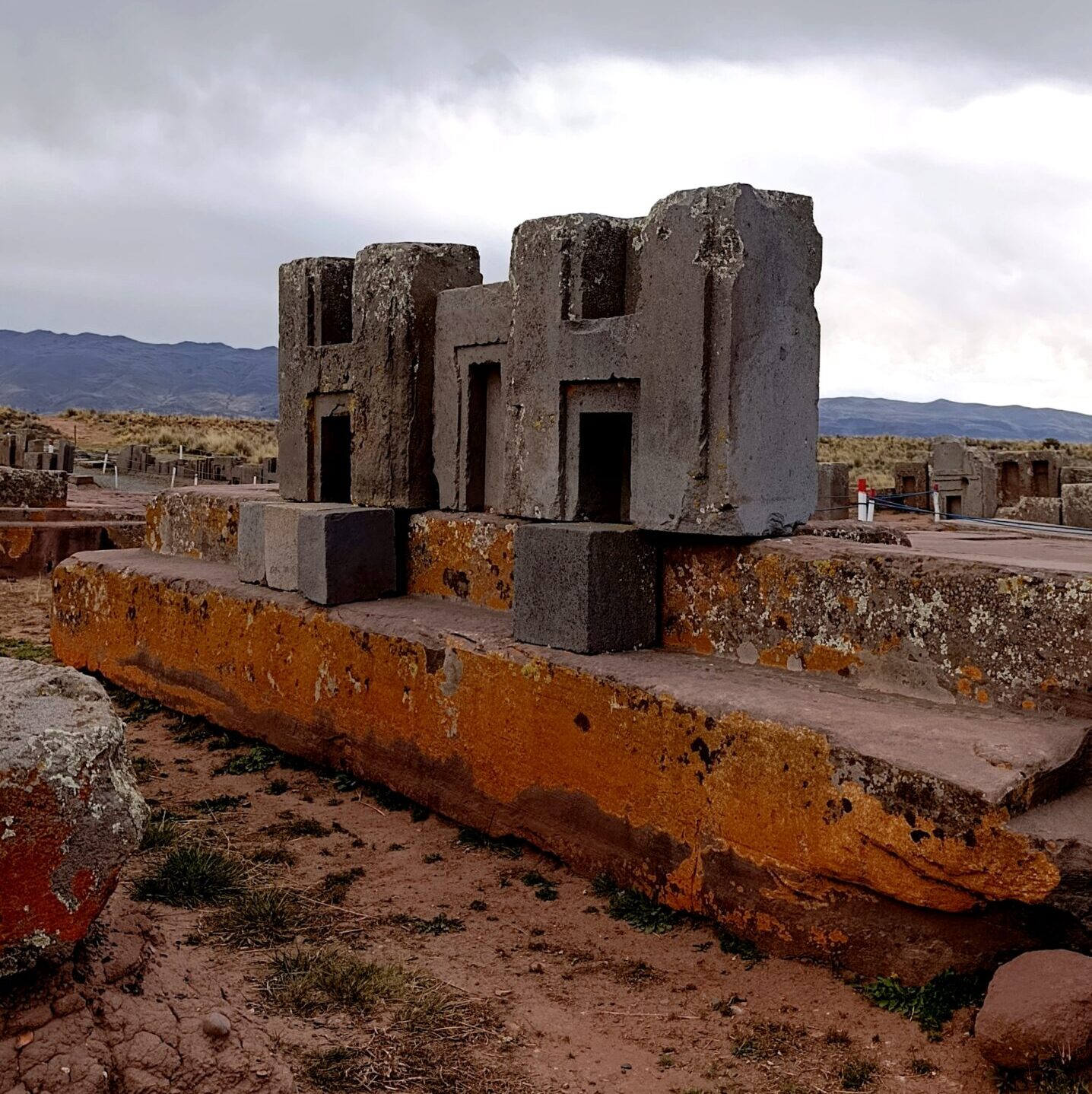
The distinctive H-shaped blocks at Puma Punku demonstrate the geometric precision achieved by Tiwanaku stoneworkers. Photo: Andrea Lastra
Archaeologists Jean-Pierre Protzen and Stella Nair investigated the stoneworking and architectural design of Puma Punku, documenting relationships among the surviving components and exploring how the original structures might have been assembled. More recently, archaeologist Alexei Vranich used digital modeling and miniature 3D-printed replicas to investigate possible arrangements of the surviving blocks.
Imagine that for a moment. Modern researchers, equipped with computers and miniature replicas, are attempting to rediscover the architectural relationships among stones carved by people who lived more than a thousand years ago.
The builders knew how the components were supposed to fit together. We are still reconstructing portions of that knowledge.
Archaeological evidence places Puma Punku within the monumental and ceremonial landscape of Tiwanaku. Excavations have identified offerings and other indications of ritual activity, although those findings don’t necessarily explain every purpose the monument served.
The site also experienced changes during its history. Some stones were reused, architectural plans appear to have evolved, and later generations dismantled or modified portions of the complex. The ruins we see today therefore represent only fragments of a much more complicated architectural story.
Yet even in their fragmented condition, the stones testify to extraordinary craftsmanship and planning. Someone conceived those geometric forms, determined their dimensions, developed methods for shaping them, and organized the work necessary to produce them.
And someone understood how the pieces were intended to become architecture.
Two Paths to Precision
At first glance, the stonework of Machu Picchu and Puma Punku might seem to represent opposite approaches to construction.
At Machu Picchu, the finest polygonal masonry demonstrates precision through the relationship between irregular stones. Each block is shaped to fit its neighbors, creating walls whose complexity emerges from the interaction of many different forms.
At Puma Punku, some of the most distinctive components demonstrate precision through individual geometry. Straight edges, repeated shapes, and carefully positioned recesses suggest architectural elements prepared according to a planned system.
One approach appears to accommodate irregularity, while the other emphasizes regularity.
Neither civilization, however, was restricted to a single style. The Inca also produced finely worked rectangular masonry, and Tiwanaku stoneworkers employed varied techniques and architectural forms. We’re comparing two particularly striking expressions of their respective traditions, not claiming that every building at either site followed the same rules.
Still, the contrast raises a fascinating question. Why would different societies develop such different methods of accomplishing something as fundamental as building with stone?
Part of the answer may lie in the materials themselves.
Machu Picchu’s builders worked extensively with locally available granite, often taking advantage of natural fractures and existing rock formations. At Puma Punku, the builders combined large sandstone elements with carefully shaped andesite components, using different materials for different architectural purposes.
Stone isn’t a uniform substance. Different rocks respond differently to cutting, hammering, abrasion, and stress. A technique well suited to one material may be less effective with another.
The intended architecture also matters. A wall assembled from individually fitted polygonal blocks presents different challenges from a monumental gateway constructed using carefully shaped components. The tools and techniques developed by the builders would naturally reflect the problems they were trying to solve.
Then there’s the influence of tradition.
Imagine a young stoneworker learning the craft from someone who has spent decades shaping rock. The apprentice watches, practices, makes mistakes, and gradually develops an understanding that cannot be acquired simply by studying a finished wall.
Now imagine that process continuing across generations. Successful methods are preserved, improved, and adapted. New challenges inspire new solutions. Over time, a society develops an extensive body of practical knowledge, much of which may never be written down.
Different traditions can produce dramatically different results, even when the people practicing them possess comparable ingenuity.
We should also remember that the Tiwanaku civilization preceded the Inca by centuries. Andean societies were not isolated islands of invention; ideas, materials, and techniques could move between communities and across generations. Determining exactly which architectural practices were inherited, adapted, or independently developed is a complicated archaeological question.
But the larger lesson remains. Human ingenuity doesn’t always follow a single path. Different circumstances, resources, ambitions, and traditions can lead to very different solutions.
And sometimes, those solutions survive long enough to astonish people who live a thousand years later.
Could We Build Them Today?
Suppose a wealthy benefactor decided to recreate the stonework of Machu Picchu and Puma Punku using modern technology.
The budget is enormous. The engineers have access to laser scanners, computer-aided design, diamond cutting equipment, heavy machinery, and precision manufacturing tools. Skilled stoneworkers and construction specialists are available from around the world.
Could they reproduce the craftsmanship?
Almost certainly.
Modern equipment can cut granite and andesite into complicated shapes, create precise surfaces, and move enormous loads. Reproducing individual stone components to comparable tolerances is well within our technological capabilities.
But that doesn’t mean recreating these sites would be easy.
At Machu Picchu, faithfully reproducing the finest polygonal masonry would require documenting and recreating complicated three-dimensional relationships among individual stones. Every surface, angle, and joint would need careful attention. Reproducing the surrounding terraces, foundations, and drainage systems would introduce further challenges.
At Puma Punku, modern machinery could manufacture replicas of the surviving geometric blocks. Yet recreating the original monument would present a different problem: portions of its architectural design remain uncertain.
We could manufacture the pieces, but we would first need to determine precisely what we intended to assemble.
There’s something wonderfully ironic about that situation. The ancient builders lacked our modern machinery, but they possessed knowledge of their own architectural plans and construction methods that we have only partially recovered.
We possess technologies they could scarcely have imagined, yet we still study their surviving stones to understand what they knew.
Given sufficient resources and reliable plans, however, modern builders could reproduce the extraordinary stonework at both sites.
Which raises a question that might be even more revealing than whether we possess the necessary technology.
Would we actually undertake such a project?
The Price of Building Something Extraordinary
Imagine presenting a proposal to recreate Puma Punku to a modern government, corporation, or wealthy investor.
Not a tourist attraction constructed from concrete and decorative stone, but a monumental structure assembled from massive blocks of carefully shaped rock, with craftsmanship intended to match the ancient original.
Engineers would calculate the requirements. Contractors would estimate the labor. Quarry operators would determine how much material was needed, and transportation specialists would develop plans for moving the largest components.
Eventually, someone would present the projected cost.
We can’t assign a meaningful dollar figure without defining the project in detail, but an authentic full-scale reconstruction would demand substantial resources. It would require a commitment far beyond the ordinary construction of a functional building.
And sooner or later, someone would ask a perfectly reasonable question.
Why are we building this?
Suppose the answer was that the structure would serve a ceremonial purpose. Would that justify the investment?
Perhaps it would. We still construct elaborate religious buildings, public monuments, memorials, and cultural landmarks whose significance extends beyond their immediate practical functions. People are willing to invest extraordinary resources in structures that express beliefs, commemorate events, demonstrate achievements, or embody shared ideals.
But the decision depends on what a society considers important.
And that brings us back to the ancient builders.
The people who constructed Machu Picchu and Puma Punku didn’t possess unlimited resources. Their societies had to provide food, organize labor, obtain materials, and sustain the work required for monumental construction.
These projects represented enormous commitments of human effort.
Yet someone decided they were worth undertaking.
We can identify some of the functions associated with Machu Picchu, including its residential, agricultural, engineered, and sacred spaces. At Puma Punku, archaeological evidence supports ceremonial significance, although the monument’s full range of purposes remains a subject of investigation.
But the word ceremonial deserves some thought.
Today, we sometimes use it to describe something symbolic rather than essential. A ceremonial event might seem secondary to the practical business of everyday life.
For an ancient society, however, the distinction might not have been so simple. Religious practices, political authority, communal identity, and obligations to the sacred could be deeply intertwined. A monumental structure associated with ceremonies might have served purposes that its builders considered fundamental to the well-being and identity of their civilization.
Perhaps the construction of such a monument was not regarded as an extravagance.
Perhaps it was regarded as a necessity.
We should be careful not to assume that we fully understand the motivations of people who lived so long ago. But we can recognize that their decisions reflected priorities powerful enough to mobilize enormous resources.
And that realization takes us beyond Machu Picchu and Puma Punku.
A Question Written Across the World
The Andes are hardly the only place where ancient civilizations devoted extraordinary resources to monumental construction.
Consider the pyramids of Egypt, whose enormous stone masses still dominate the desert landscape thousands of years after their construction. Or the temples of Angkor in Cambodia, where elaborate stone architecture formed part of an immense religious and political landscape. Think of the great stone monuments of prehistoric Europe, or the monumental cities and ceremonial centers built by civilizations across the Americas.
These places differ enormously in age, purpose, construction methods, and cultural meaning. We shouldn’t imagine that they all emerged from the same motivations or required the same kinds of engineering knowledge.
But they share something remarkable.
Their builders committed substantial portions of their societies’ resources to projects whose significance extended beyond the immediate needs of shelter and survival.
The people responsible for these undertakings could not have known exactly how future generations would regard their accomplishments. Some structures were intended to endure, while others may have been transformed, rebuilt, or repurposed over time.
Yet again and again, civilizations chose to build on an extraordinary scale.
Why?
The answers undoubtedly varied. Religious devotion, political authority, communal identity, practical necessity, and the desire to leave something lasting may all have played roles, depending on the place and period.
But perhaps the most revealing comparison is not between ancient builders and modern engineers. Perhaps it’s between the things different societies consider worth the effort.
We possess machines capable of moving mountains of earth, carving enormous quantities of stone, and constructing buildings that reach into the clouds. Our technological capabilities exceed those of ancient civilizations in countless measurable ways.
Yet the ability to build something doesn’t determine whether we will build it.
That decision depends on what we value.
The Stories We Cannot Hear
Return, for a moment, to the mountains of Peru.
Imagine standing before one of Machu Picchu’s finely fitted walls, tracing the complicated boundary between two stones. Someone shaped those surfaces centuries ago, making countless small decisions that contributed to the finished structure. The craftsperson’s name may be lost to history, but the evidence of that person’s skill remains beneath your fingertips.
Now travel in your imagination to Puma Punku, where enormous slabs and carefully shaped geometric blocks lie scattered across the Bolivian highlands. Their original arrangements may be partly lost, but the precision of their workmanship remains unmistakable.
At both places, it’s difficult not to feel awe. Not merely because the stones are large or their shapes extraordinary, but because of what they represent. Behind every carefully worked surface were people who understood their craft, societies capable of organizing immense undertakings, and purposes important enough to justify the effort.
We can study the geology, measure the angles, examine the tool marks, and develop increasingly sophisticated explanations for how the stones were shaped and assembled. We may even recreate their craftsmanship with modern machinery.
But the more closely we examine these ancient achievements, the more we encounter questions that cannot be answered by engineering alone.
What did these structures mean to the people who built them? What hopes, obligations, ambitions, or beliefs made such enormous efforts worthwhile? And how differently might we see these monuments if we could understand the world through their builders’ eyes?
Perhaps that’s why ancient stonework continues to fascinate us. The stones preserve evidence of extraordinary human capabilities, but they also remind us that technical knowledge is only part of the story.
Being capable of building something and believing it’s worth building are two very different things. The monuments of ancient civilizations are extraordinary expressions of both.
The stones remain. The people who placed them there knew the stories.
We’re still trying to piece them together.
Sources and Further Exploration
- UNESCO World Heritage Centre — Historic Sanctuary of Machu Picchu. https://whc.unesco.org/en/list/274
- UNESCO World Heritage Centre — Tiwanaku: Spiritual and Political Centre of the Tiwanaku Culture. https://whc.unesco.org/en/list/567
- Jean-Pierre Protzen (1985), “Inca Quarrying and Stonecutting.” Journal of the Society of Architectural Historians. https://doi.org/10.2307/990027
- Jean-Pierre Protzen and Stella E. Nair (2001), “Pumapunku: plataformas y portales.” Boletín de Arqueología PUCP. https://doi.org/10.18800/boletindearqueologiapucp.200101.012
- Alexei Vranich (2018), “Reconstructing Ancient Architecture at Tiwanaku, Bolivia: The Potential and Promise of 3D Printing.” Heritage Science. https://doi.org/10.1186/s40494-018-0231-0